AMStressForge
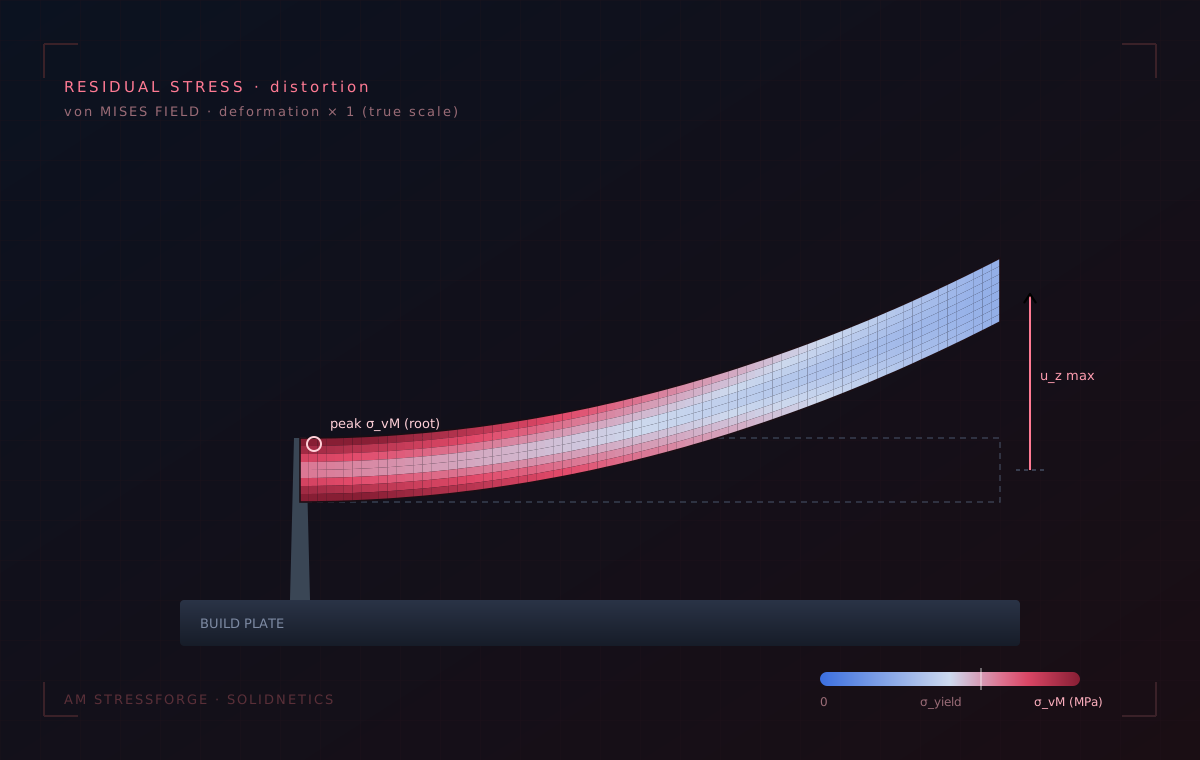
The thermo-mechanical solver. StressForge takes the thermal history and predicts what every LPBF engineer fears — residual stress, warping, and cracking — the failure modes that decide whether a part is scrapped or shipped.
What StressForge is
The failure-mode predictor of the AM stack. StressForge takes the thermal history, pulls local strength from GrainPath, and runs a quasi-static elasto-plastic FEM on the part — mirroring the build layer by layer, all the way through release from the build plate.
Reads the heat
Takes the full thermal history from FusionCore, or an inherent-strain map from FusionMap for fast part-scale runs, plus microstructure for local strength.
Forges the stress
Solves equilibrium with temperature-dependent, Hall–Petch-modified yield as each layer is added — then releases the part to capture springback.
Predicts the risk
Outputs von Mises and principal stress, full distortion, plastic strain, stress triaxiality and yielded fraction — the cracking-risk picture.
Inside the engine
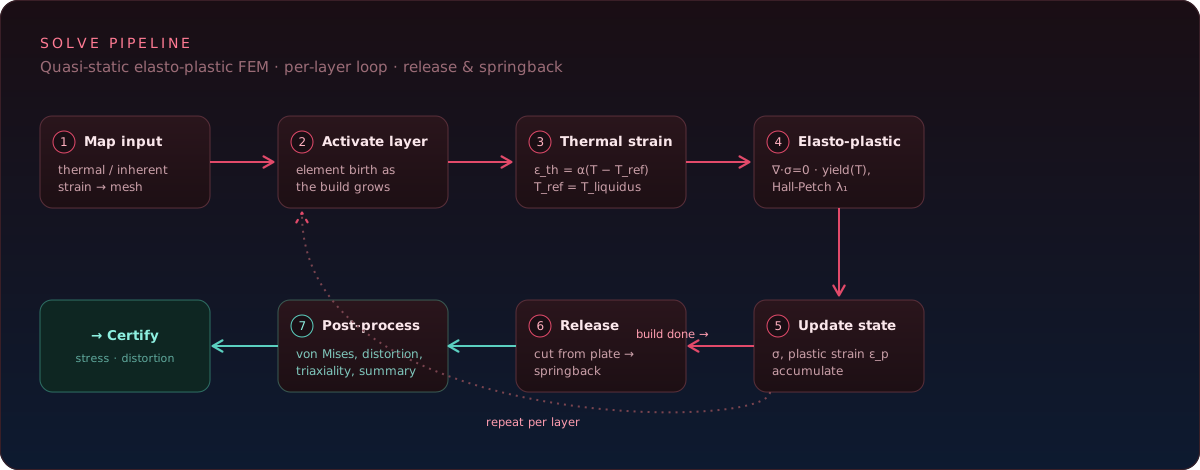
The solve mirrors the build: each layer is activated, loaded by its thermal strain, and brought to equilibrium with the layers below. The real residual state appears only at release, when the part is cut from the plate and springs back.
Capabilities
Six features that decide whether a part ships or gets scrapped.
Layer-activated elasto-plastic FEM
Quasi-static elasto-plastic FEM, solved layer by layer as the build grows — exactly mirroring the physical process:
- Each layer activated at its build time
- Loaded by its thermal strain (from FusionCore's T(t) field)
- Brought to equilibrium with all previously-built layers
- Production-grade FEniCSx (DOLFINx) backend
Temperature-dependent constitutive model
Stress prediction is only as good as the material model behind it. StressForge runs a T-dependent, isotropic-hardening plasticity:
- State-dependent Young's modulus E(T) and CTE α(T)
- Temperature-dependent yield σy(T) with isotropic hardening
- Thermal strain integrated from FusionCore's T(t) history
- Stress-free reference at the activation temperature of each layer
ε = εel + εth + εp

εth = α(T)·(T − Tref)·I

f(σ, T) = σ̄ − σy(T, ε̄p) ≤ 0

E(T) · α(T) · σy(T) — T-dependent
Hall–Petch microstructure coupling
GrainPath's PDAS map flows directly into the local strength field — fine grains forge stronger metal:
- σy = σy0 + kHP / √λ₁ per node
- Higher cooling rates → finer dendrite arms → higher local yield
- The columnar / equiaxed map shows up directly in the stress distribution
- kHP calibrated per alloy from published EBSD–tensile measurements
σy(node) = σy0(T) + kHP / √λ₁

σy0 · base yield (T-dependent)
kHP · Hall–Petch slope [MPa·µm1/2]
λ₁  · PDAS from GrainPath [µm]

node 14201 → σy = 612 MPa
Two solve modes
Pick fidelity against the budget. Full-history mode for highest accuracy; inherent-strain mode (powered by FusionMap) for whole-part iteration inside the optimisation loop.
Layer-by-layer FEM
Highest-fidelity residual stress driven by FusionCore's full T(t). Best for validation, anomaly investigation, qualification.
Part-scale FEM
Reads an ε* map directly from FusionMap — no thermal solve needed. Enables whole-part iteration in the optimisation loop.
A full failure-mode output set
StressForge writes the fields qualification reports actually cite:
- von Mises and principal stresses (σ₁, σ₂, σ₃)
- Displacement & warping — full 3D, true scale
- Springback — distortion captured at release from the plate
- Plastic strain (εp) and yielded-volume fraction
- Stress triaxiality for ductile-fracture risk assessment
Validated materials & solver stack
Calibrated presets for the canonical LPBF alloys — including E(T), α(T), σy(T), and a per-alloy kHP:
All mechanical parameters are user-overridable through the Material Library.
The data contract
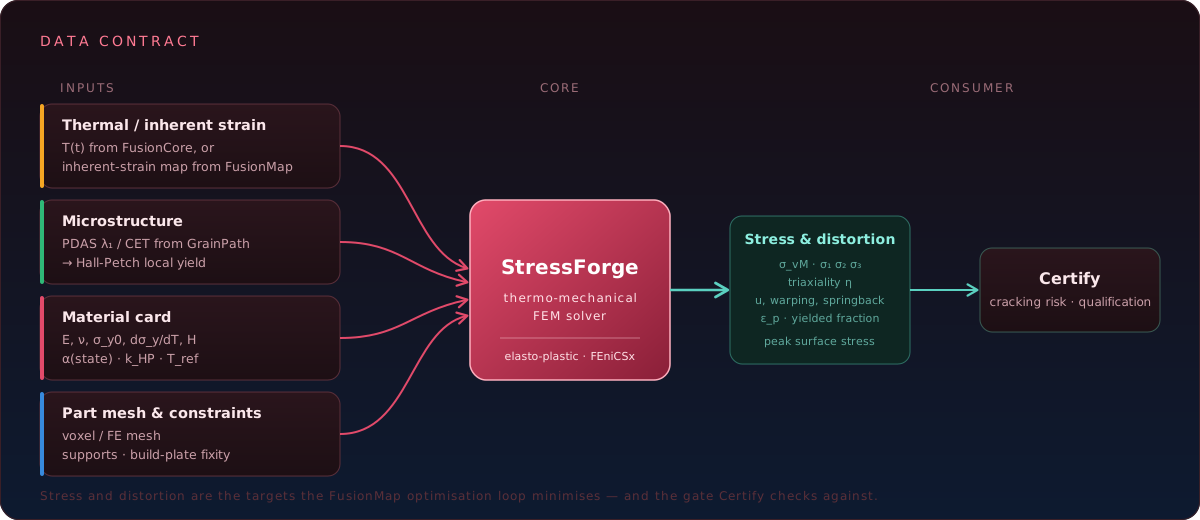
StressForge ties the whole chain together — heat from FusionCore, strength from GrainPath, material card and constraints in. Its stress and distortion fields are both the target the FusionMap optimiser minimises and the gate CertifyAM checks against.
Where it sits
StressForge is the second prediction branch alongside GrainPath — the one that produces the numbers customers actually qualify a part on — converging into CertifyAM.
Why cloud
Layer-activated FEM is heavy. SolidNetics elastically scales those solves across cloud workers so a full-part residual-stress run finishes overnight, not over a week.
Elastic CPU scaling
From quick inherent-strain runs to full layer-activated FEM, scaled across high-core cloud instances. Pay for the run, not the workstation.
Stack-native input
Reads FusionCore's thermal history and GrainPath's PDAS directly — same mesh, no remeshing, no field interpolation.
Traceable for qualification
Every output field is stamped with the input field versions and material-card hash — a defensible chain for audit.
From history to stress
Three steps from thermal fields to a full residual-stress prediction.
Load history & strength
Pick a thermal history (FusionCore) or an inherent-strain map (FusionMap), with the GrainPath PDAS field.
Solve layer-by-layer & release
Each layer activated, thermal strain applied, equilibrium found — then the part released to capture springback.
Read the failure map
von Mises, σ₁₂₃, triaxiality, plastic strain, warping and springback — ready to drive CertifyAM.
Applications
Built for LPBF process engineers killing distortion before metal is wasted, structural engineers qualifying parts against residual-stress limits, and qualification teams defending stress maps in regulatory audit.
Predict the warp. Predict the crack. Ship the part.
StressForge is part of the SolidNetics AM module. Talk to us about access for your team, machine fleet, or research group.