AMCertifyAM
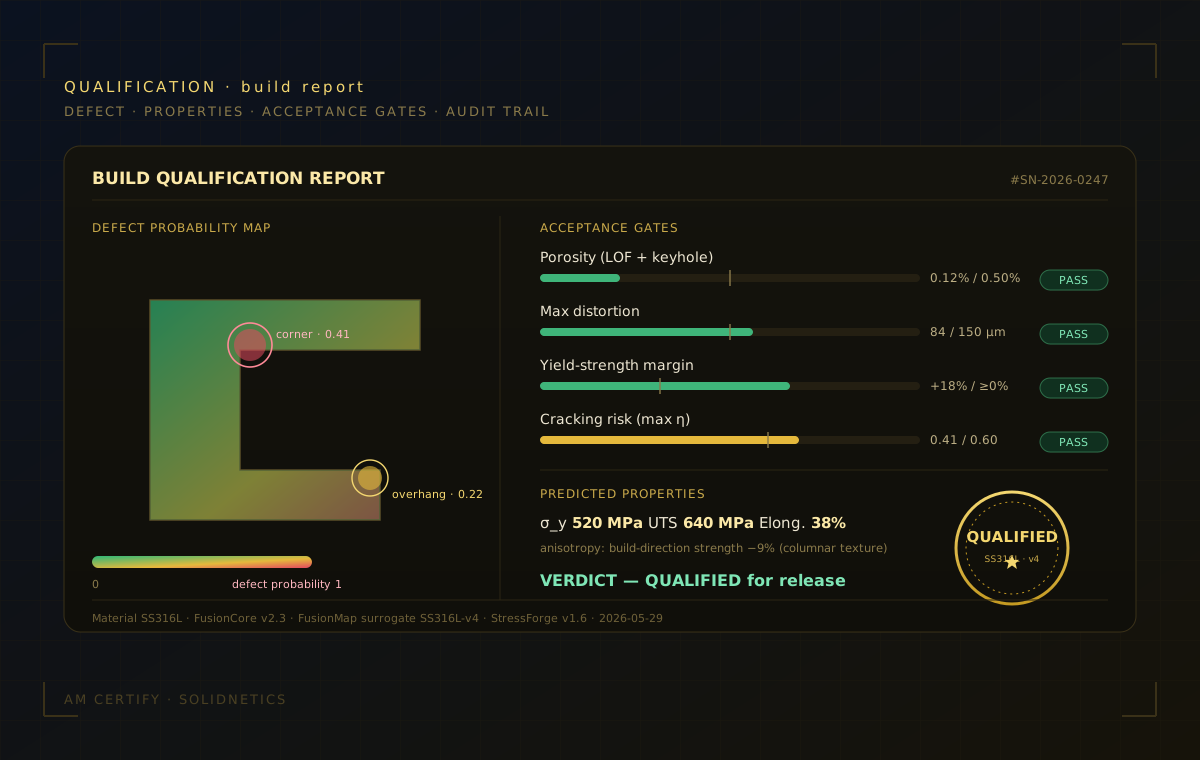
The quality assessor. CertifyAM consolidates everything the stack predicted into defect-probability maps, property estimates, and a pass/fail verdict — the audit-ready report that turns a simulation into a release decision.
What CertifyAM is
Every solver before it produces a field; CertifyAM produces a decision. The terminal node of the AM stack — where thermal, microstructure, and mechanical predictions are weighed against acceptance criteria and packaged for an auditor.
Consolidates
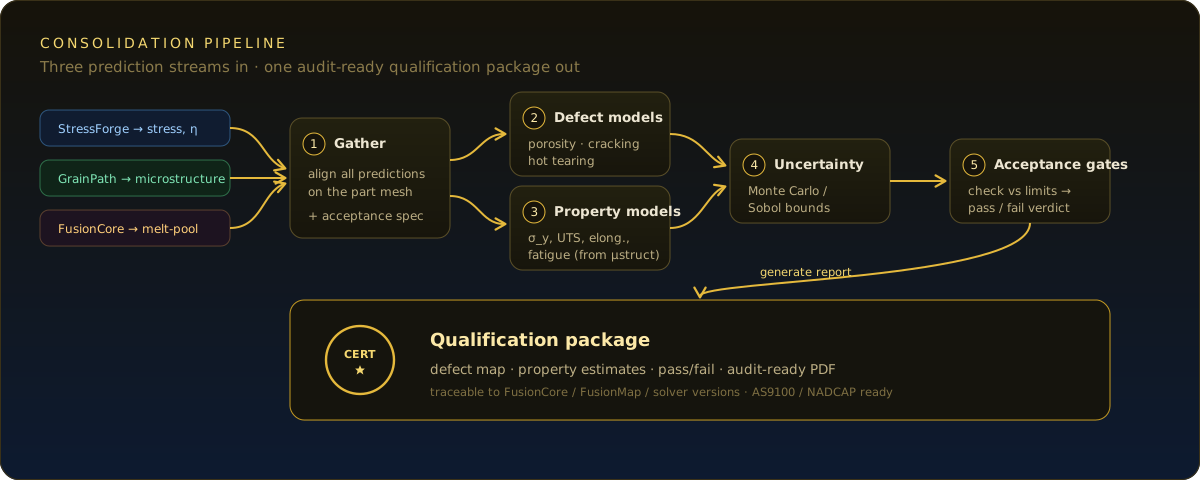
Gathers stress and distortion from StressForge, microstructure from GrainPath, and melt-pool porosity indicators from FusionCore — aligned on one part mesh.
Predicts the part
Runs defect models for porosity and cracking, property models for strength and fatigue, and quantifies the uncertainty around each.
Certifies
Checks every result against the spec, issues a pass/fail verdict, and emits a traceable, audit-ready qualification package.
Inside the engine
Three prediction streams converge, run through defect and property models, pick up uncertainty bounds, and meet the acceptance gates. What comes out is a single document an engineer can sign — traceable all the way back to the physics that generated it.
Capabilities
Six features that turn a stack of physics fields into a signed release decision.
Defect probability maps
Three categories of LPBF defects, classified per voxel and rolled up across the part:
- Lack-of-fusion porosity — from sub-threshold energy density
- Keyhole porosity — from over-energy / deep melt-pool indicators
- Solidification cracking — from triaxiality at the mushy-zone exit
- Hot-tearing risk — from solidification range × strain at the freezing front
Mechanical property prediction
Microstructure from GrainPath drives a full mechanical-property estimate, with explicit build-direction anisotropy:
- Yield strength σy from local PDAS (Hall–Petch)
- Ultimate tensile strength UTS and elongation at fracture
- Fatigue life from defect population × stress amplitude
- Anisotropy — XY-plane vs build-direction property pair, per voxel
build XY
build Z
build XY
at fracture
Uncertainty quantification
Every prediction carries a confidence — not just a number. CertifyAM runs UQ across the input chain:
- Monte Carlo sampling over material card & surrogate-model uncertainty
- Sobol sensitivity indices tell you which upstream parameters drove the spread
- Confidence bounds on defect probability, every predicted property, and every gate
- FusionMap's model-card uncertainty propagates straight through
Sobol indices (build XY σy)

PDAS field ............ 0.42
kHP ................. 0.28
thermal history ....... 0.18
material card ......... 0.08
other ................. 0.04

⟶ tighten PDAS → halve the spread
Acceptance gates & verdict
User-defined limits on every predicted field. Each gate gets an explicit pass/fail; the overall verdict is the AND of every gate:
- Pick limits from a standard preset (AS9100, NADCAP) or define your own
- Per-gate pass/fail with margin — see how close to the limit
- Per-voxel hot-spot localisation — where the part is closest to the limit
- Overall QUALIFIED / CONDITIONAL / REJECTED verdict seal
Audit-ready reporting
Every certification package is built for the inspector, not just the engineer:
- Single qualification PDF with defect map, properties, gates, and verdict
- Every prediction traceable to the solver and surrogate-model versions
- Material-card hashes and process-parameter snapshot included by default
- Built for AS9100 / NADCAP workflows out of the box
- Machine-readable JSON sidecar for MES / PLM integration
Pre-built gate templates per standard.
The terminal node of the AM stack
CertifyAM is where the whole pipeline pays off:
- Consumes all four upstream solvers — PathWeaver, FusionCore, GrainPath, StressForge
- Hands off to release — the build either ships, gets reworked, or is killed
- Same report drives both the FusionMap optimisation loop and the human qualification sign-off
- No downstream solver — its consumer is the engineer, the auditor, and the build release
The data contract
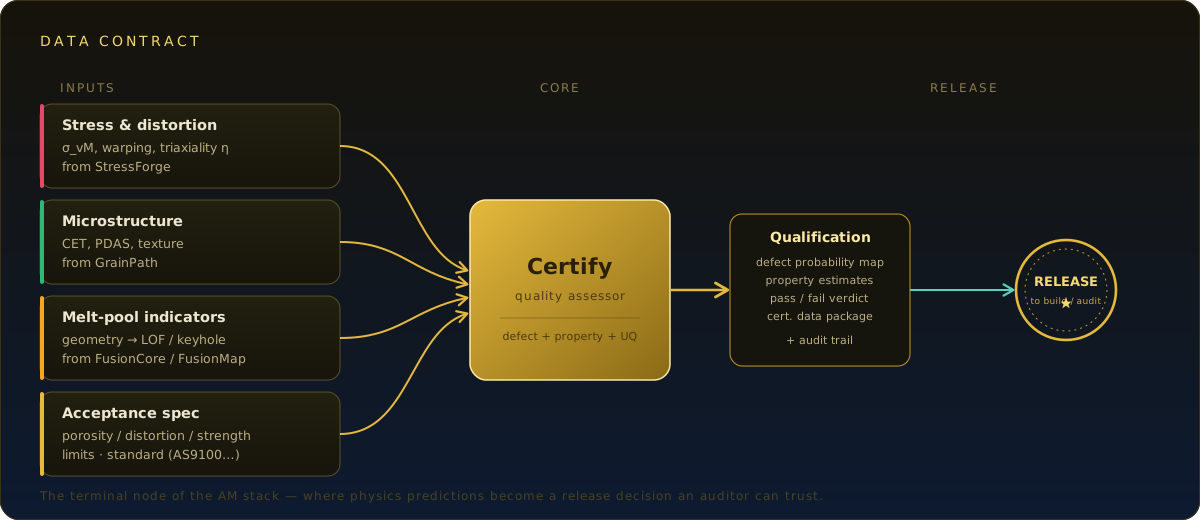
CertifyAM has no downstream solver — its consumer is the engineer, the auditor, and the build release. The whole pipeline pays off here: physics predictions become a decision someone can trust against AS9100 or NADCAP.
Where it sits
CertifyAM is where the two prediction branches — microstructure and stress — converge. It closes the chain that began with a single STL in PathWeaver.
Why cloud
No spreadsheets. No copy-paste sign-offs. No version drift. Every gate, every prediction, and every report pins back to the exact solver and material-card versions that produced it. The chain is the audit trail.
Audit-ready by default
Every report traceable to the solver versions, surrogate cards, and material data that produced it — built for AS9100 / NADCAP from day one.
Optimiser target
FusionMap's loop minimises gate margins — every iteration produces a fresh, scored CertifyAM report.
Always up to date
New gate templates, defect models, and standards roll out automatically — no recompile.
From four streams to a verdict
Three steps from a stack of physics fields to a signed qualification package.
Consolidate four streams
Pull thermal, microstructure, and mechanical fields from the upstream solvers — aligned on the same part mesh.
Pick a standard & gates
AS9100, NADCAP, ISO/ASTM, or your own custom limits. Defect, property, and distortion gates in one place.
Issue the verdict
Pass / Conditional / Fail per gate and overall, signed PDF + machine-readable JSON, traceable to the whole chain.
Applications
Built for AM qualification teams defending parts in regulated industries, AM service bureaus issuing release reports, and AM machine builders validating new process windows against acceptance criteria.
From a stack of fields to a signed verdict
CertifyAM is part of the SolidNetics AM module. Talk to us about access for your team, machine fleet, or research group.