AMGrainPath
The microstructure solver. GrainPath reads the solidification fields and predicts the grains themselves — columnar or equiaxed, fine or coarse, textured or random — the bridge from a part's thermal history to how it will actually behave.
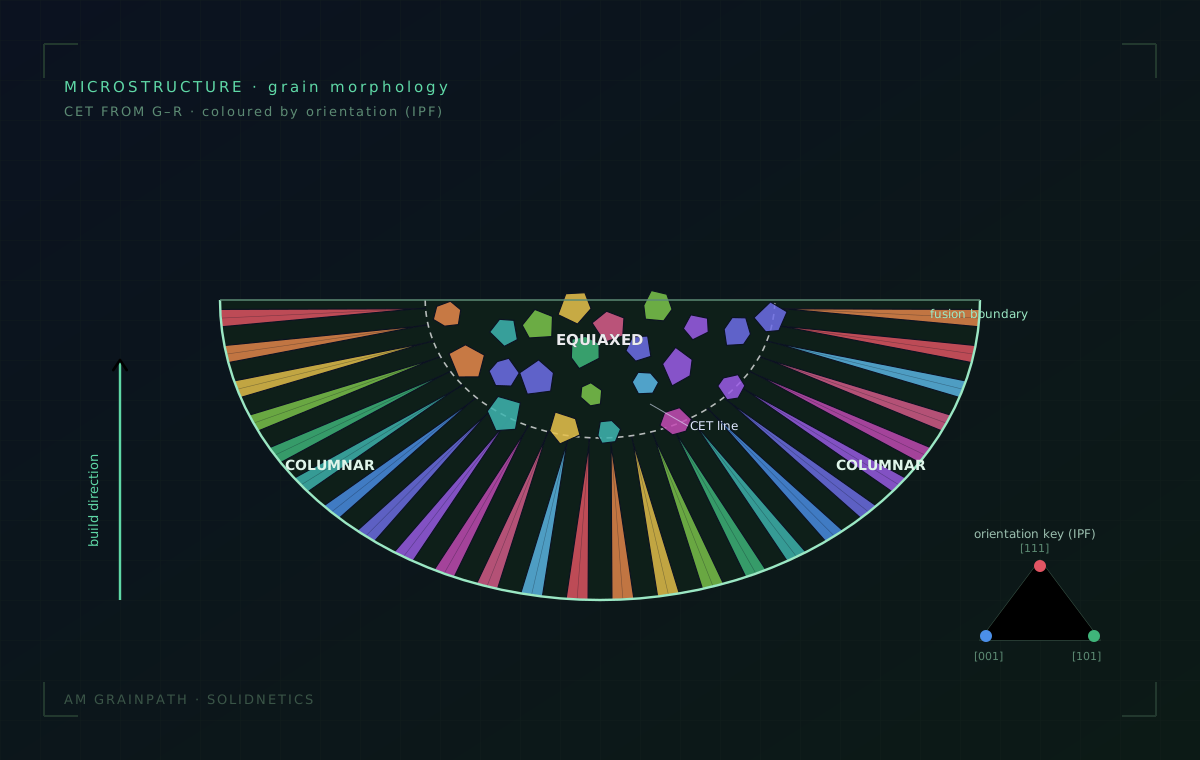
What GrainPath is
A lightweight post-processor on the solidification fields — not a new simulation. Where FusionCore answers "how hot did it get?", GrainPath answers "what did the metal become?" — columnar near the fusion boundary, equiaxed in the cooled core, textured with the build direction.
Reads the gradients
Takes thermal gradient G, solidification velocity R and cooling rate Ṫ at every solidified node — the standard inputs to the G–R map.
Classifies the growth
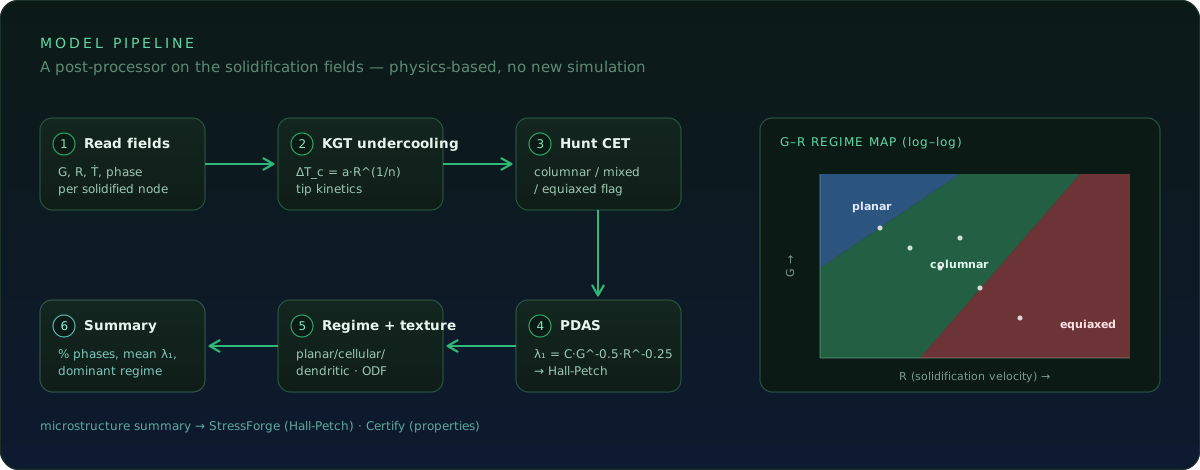
Applies the Hunt CET criterion and KGT undercooling to flag columnar vs equiaxed, and Hunt–Lu to estimate primary dendrite arm spacing.
Predicts the grains
Outputs CET, PDAS, solidification regime, texture and phase-fraction maps, plus an aggregate microstructure summary.
Inside the engine
Each solidified node walks the same chain: undercooling → CET criterion → dendrite spacing → regime → texture. Every point lands somewhere on the classic G–R map — the diagram that says whether you get planar, cellular, columnar or equiaxed growth.
Capabilities
Six features that turn a thermal field into a microstructure prediction.
Hunt CET classification
Per-node columnar-to-equiaxed transition flag, using Hunt's criterion with KGT undercooling:
- Columnar when G/R is high — grains grow inward from the fusion boundary
- Equiaxed when G/R drops below threshold — nuclei survive ahead of the front
- Mixed band in the transition zone
- Threshold tuned per alloy from CALPHAD data and nucleation parameters
Primary dendrite arm spacing (PDAS)
PDAS sets local grain size — and grain size sets local strength via Hall–Petch:
- Hunt–Lu relation: λ₁ = C · G-0.5 · R-0.25
- Faster cooling → finer arms → stronger metal
- Per-node λ₁ map feeds StressForge's local strength field
- Calibrated coefficients per alloy
λ₁ = C · G-0.5 · R-0.25

C  · alloy constant
G  · thermal gradient [K/m]
R  · solidification velocity [m/s]

⟶ Hall–Petch: σy ∝ λ₁-1/2
G–R regime classification
Every solidified node lands somewhere on the log–log G–R map. GrainPath classifies four canonical regimes:
node 14201
  G       = 1.8e7 K/m
  R       = 0.62 m/s
  ΔT_c    = 24.1 K
  regime  = columnar dendritic
  CET     = columnar
  λ₁      = 8.4 µm
  texture = ⟨001⟩ // BD
Explicit grain growth (optional)
When you need actual morphology — not just classification — GrainPath can engage an explicit grain-growth solver:
- Cellular Automata (CA) · efficient grain envelopes with nucleation and capture rules
- Phase-Field (PF) · diffuse-interface morphology for highest-fidelity grain shapes
- Outputs explicit orientation maps (IPF colouring) and an ODF
- Engaged on selected sub-volumes — too expensive for the whole part
Texture & orientation distribution
Columnar grains carry a preferred crystallographic orientation — which becomes part-scale anisotropy:
- Dominant ⟨001⟩ texture aligned with the build direction in columnar zones
- Randomised texture in equiaxed zones
- Per-node Orientation Distribution Function (ODF) for downstream anisotropic stress models
- Inverse-pole-figure (IPF) colouring for visualisation
build-direction texture
isotropic
spherical harmonics
RGB orientation triangle
Validated materials & almost-free compute
Calibrated material cards for the canonical LPBF alloys, with constants tuned to published EBSD measurements:
As a post-processor on existing fields, GrainPath runs in minutes — not hours. Add it to any FusionCore or FusionMap result with no extra simulation.
The data contract
GrainPath is where physics becomes properties. Its grain-size and orientation maps feed StressForge — through Hall–Petch, finer grains mean higher local strength — and feed CertifyAM, where microstructure drives the predicted mechanical performance.
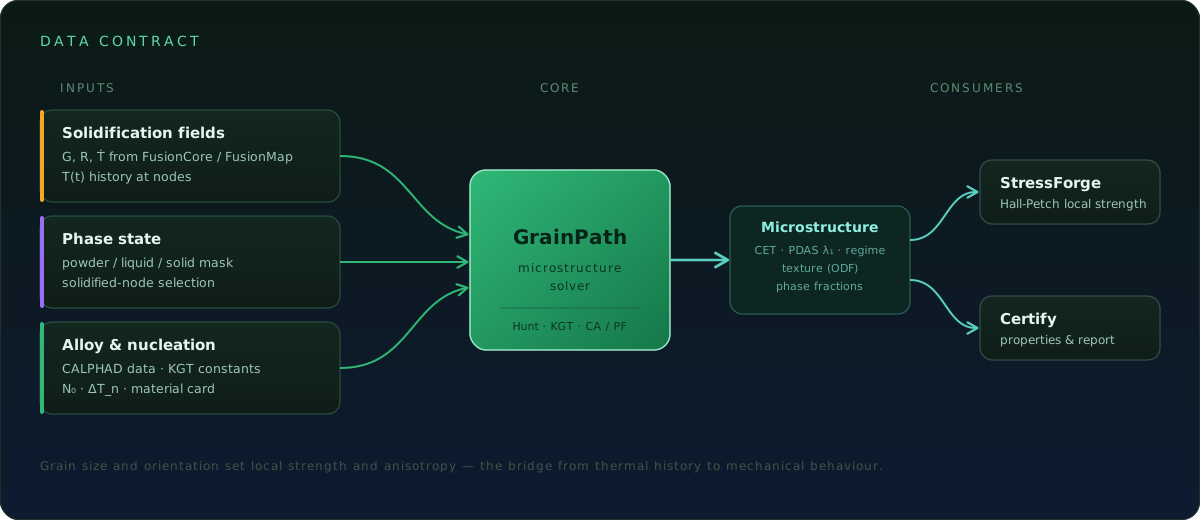
Where it sits
GrainPath is one of the two prediction branches fed by the thermal history — microstructure here, residual stress in StressForge — both converging in CertifyAM.
Why cloud
GrainPath chains directly off FusionCore's output — and runs in minutes on cloud workers, not hours on a workstation.
Free with FusionCore
GrainPath is a post-processor — reuses the existing fields, mesh, and material card. One run, two outputs.
Minutes, not hours
Hunt + KGT classification scales linearly with node count. Even part-scale runs finish in minutes.
Always up to date
New alloy presets, CA/PF improvements, and texture analytics roll out automatically — no recompile.
From fields to microstructure
Three steps from solidification fields to a complete microstructure map.
Pull G, R, Ṫ fields
From any FusionCore or FusionMap run — no extra simulation, no extra mesh.
Apply the chain
KGT undercooling → Hunt CET → Hunt–Lu PDAS → regime → optional CA/PF growth.
Read the maps
CET, PDAS, regime, texture, and phase-fraction maps — visualised in 3D and consumed downstream.
Applications
Built for LPBF metallurgists predicting build-direction anisotropy, process engineers tuning parameters for desired grain morphology, and qualification teams justifying microstructure-driven property maps.
From thermal history to the grains themselves
GrainPath is part of the SolidNetics AM module. Talk to us about access for your team, machine fleet, or research group.