PINNStress Analysis
Mesh-free structural simulation powered by Physics-Informed Neural Networks. Embed the equations of linear elasticity directly into a neural network — no meshing, geometry-flexible, GPU-accelerated.
Overview
A modern, mesh-free approach to 3D structural analysis. By embedding the equations of linear elasticity directly into a neural network, this tool eliminates meshing, simplifies setup, and enables fast, geometry-flexible simulation entirely in the cloud — with full control over network architecture and training parameters.
Direct CAD ingest
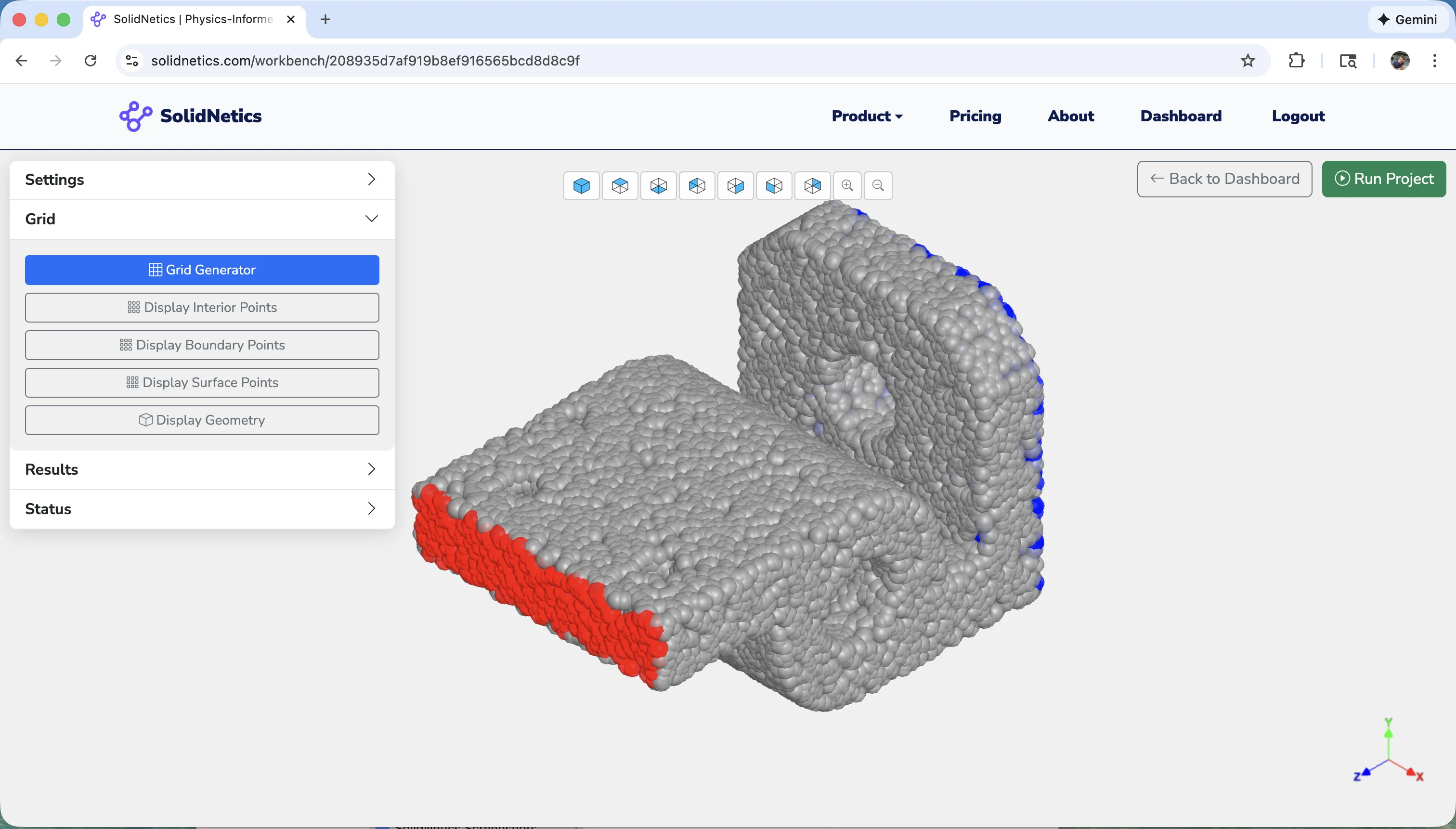
STL, STEP and IGES files supported. No meshing required — the geometry is sampled as collocation points.
PINN loss
The elasticity PDE residual is baked into the loss function alongside boundary-condition penalties. Train the network, solve the physics.
Stress & strain
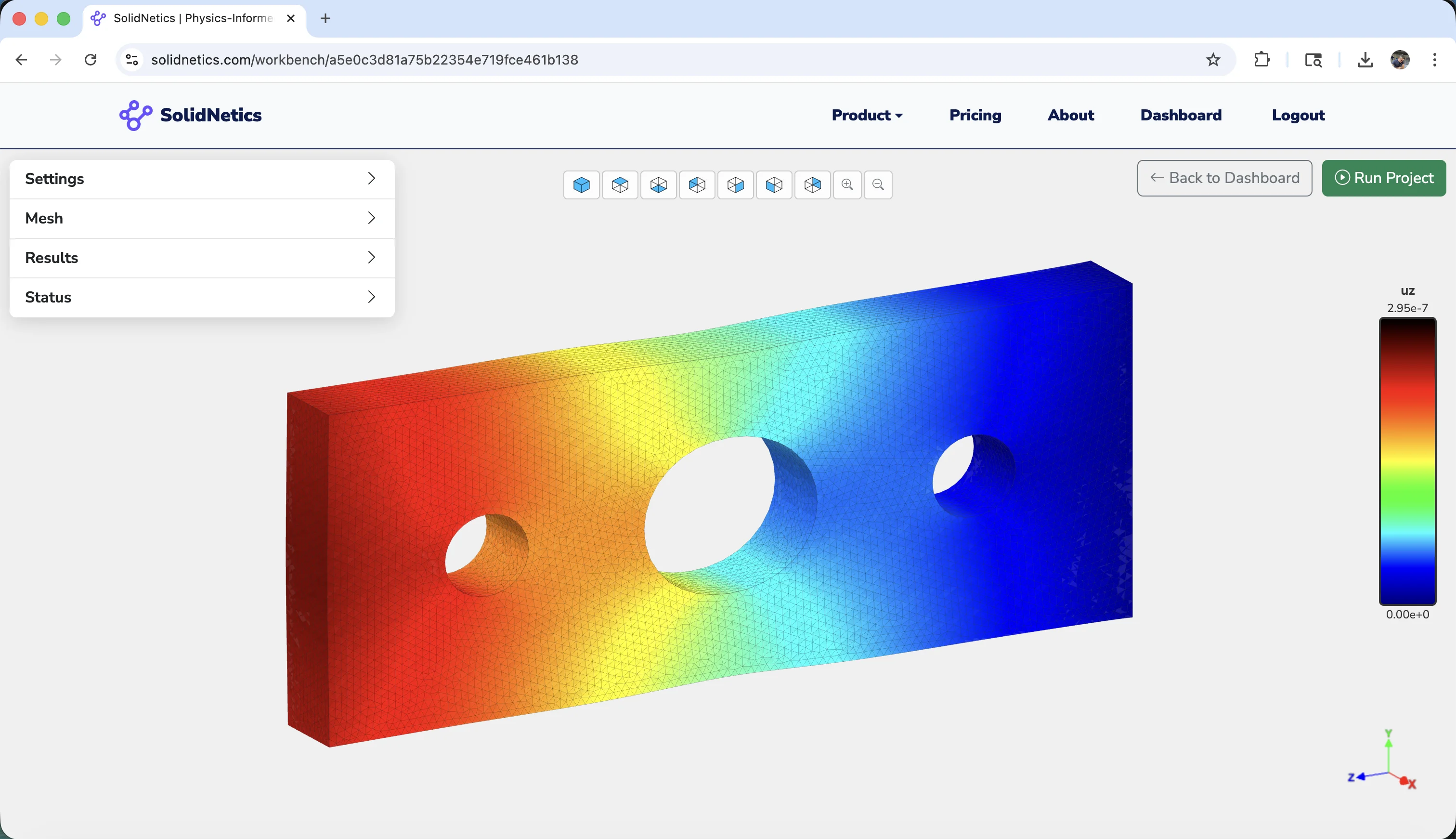
Solve stresses, strains and displacements directly — visualised in 3D from the trained model anywhere in the geometry.
The PINN workflow
No mesh generation, no element-matrix assembly. The geometry is sampled as interior collocation points and boundary points; the network learns the displacement field by minimising the PDE residual.
Capabilities
Six features that make PINN a viable engineering tool, not just a research toy.
Mesh-free simulation via PINNs
The neural network is the solver. Forget element generation, mesh quality checks, and remeshing:
- Geometry sampled as collocation points, not elements
- Physics encoded as a residual loss term
- Field values evaluable anywhere in the geometry, not just at nodes
- Continuous, differentiable output by construction
Direct CAD input
The same CAD pipeline as the FEA solver — no extra prep work:
- STL, STEP, IGES file support
- Automatic boundary & interior point sampling from the geometry
- Adjustable point density for resolution control
- Multi-body part support
Linear elasticity with isotropic materials
Solid foundations for the v1 release:
- Linear elasticity PDE encoded in the loss
- Isotropic material model (E, ν)
- Small-strain assumption
- Static / quasi-static loading
Anisotropic materials, nonlinear models, and contact problems on the roadmap.
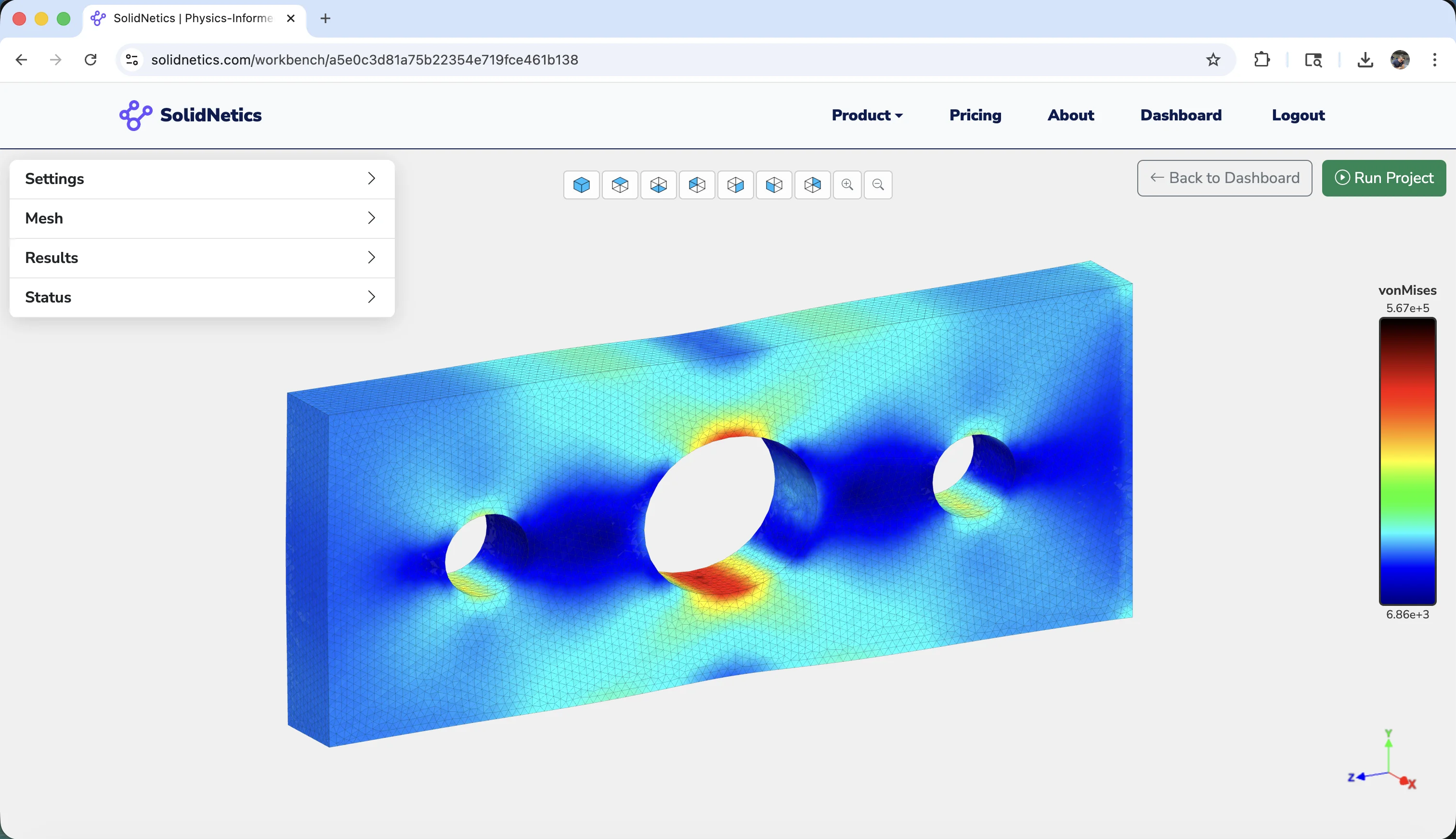
Flexible boundary conditions
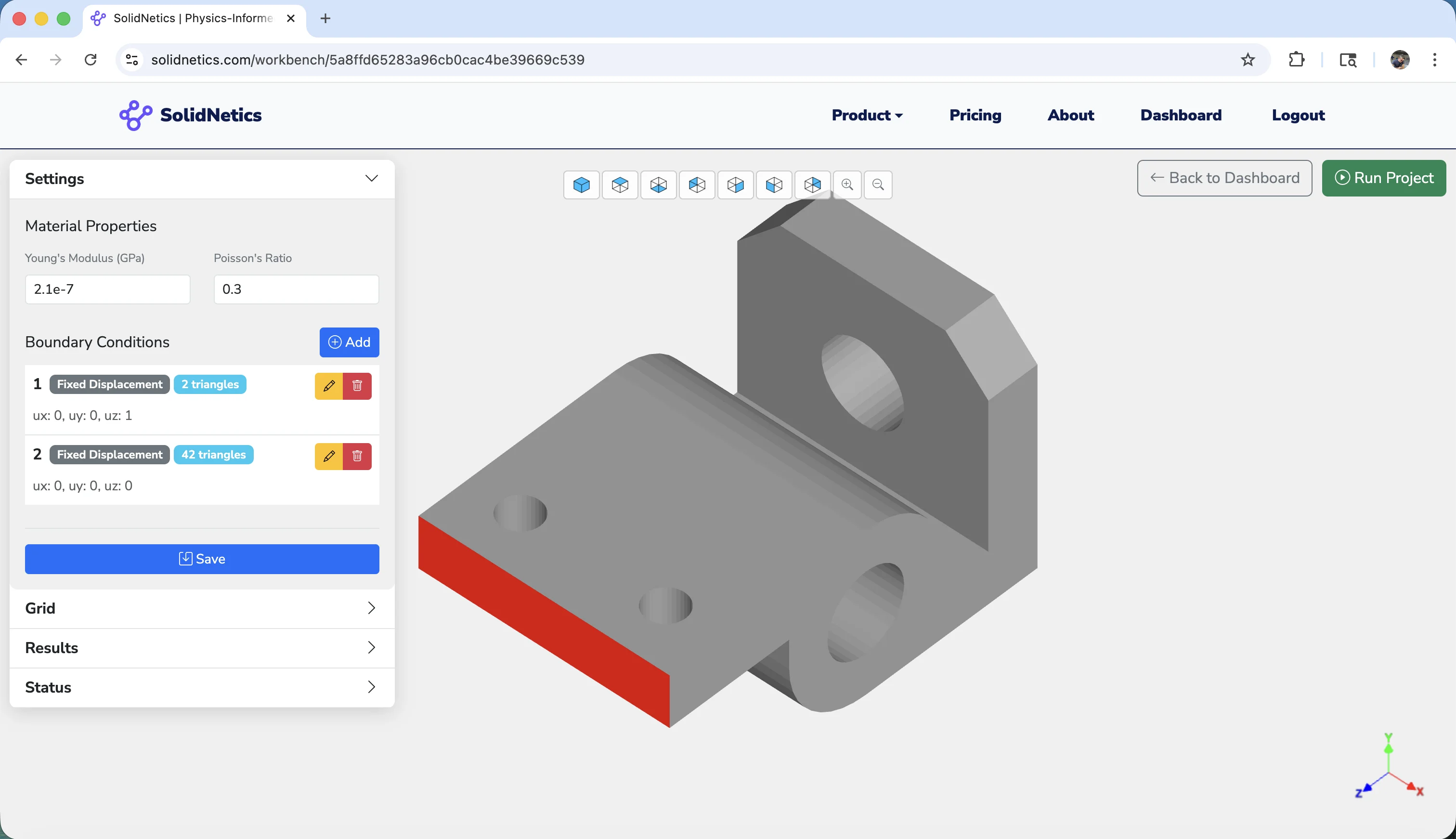
The same visual BC assignment as FEA — applied as soft constraints in the loss:
- Displacement · fixed, prescribed, symmetry
- Traction / pressure loads on surfaces
- Line loads and lumped forces
- Per-BC loss weighting for hard vs soft constraints
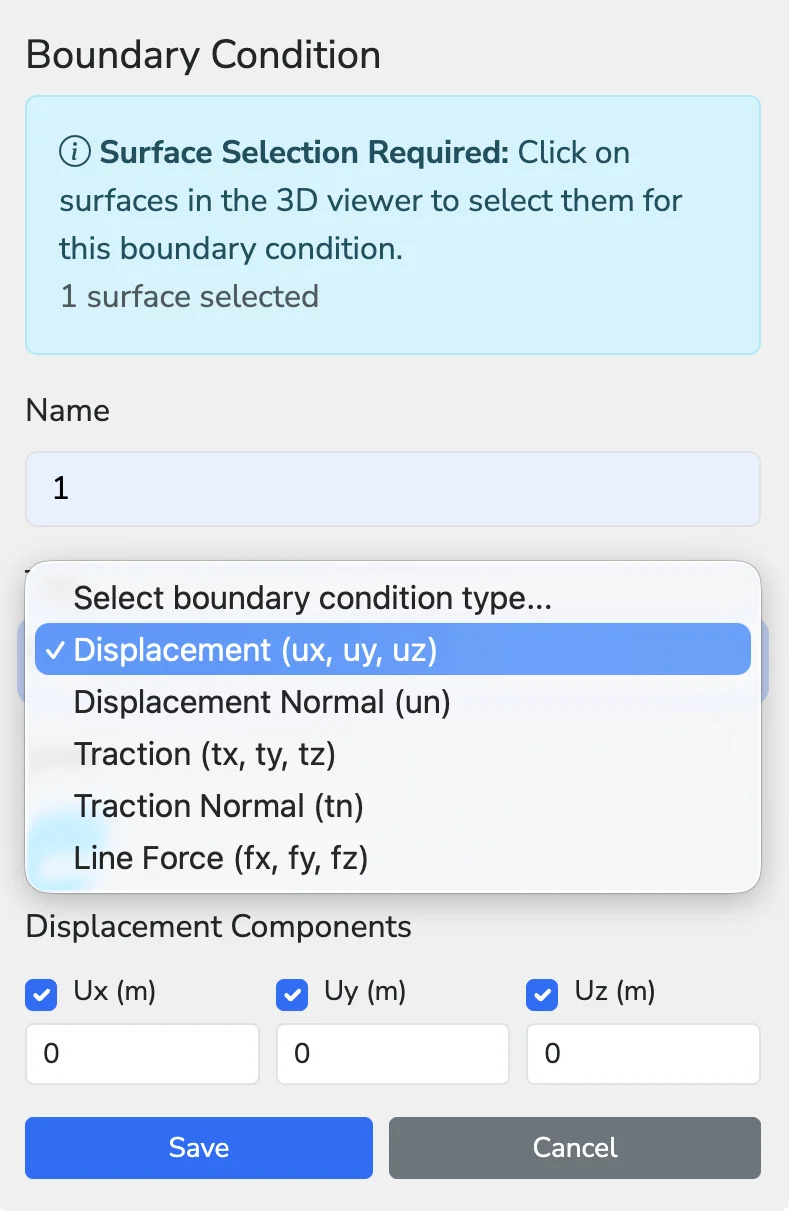
Complete control over training
Every PINN parameter is exposed — tune the network for your problem:
- Architecture · hidden layers, neurons per layer, activations
- Optimiser · Adam, L-BFGS, learning-rate schedule
- Loss weighting · interior PDE, BC, normalisation
- Sampling strategy · uniform, Latin hypercube, adaptive
- Live loss curves and convergence diagnostics
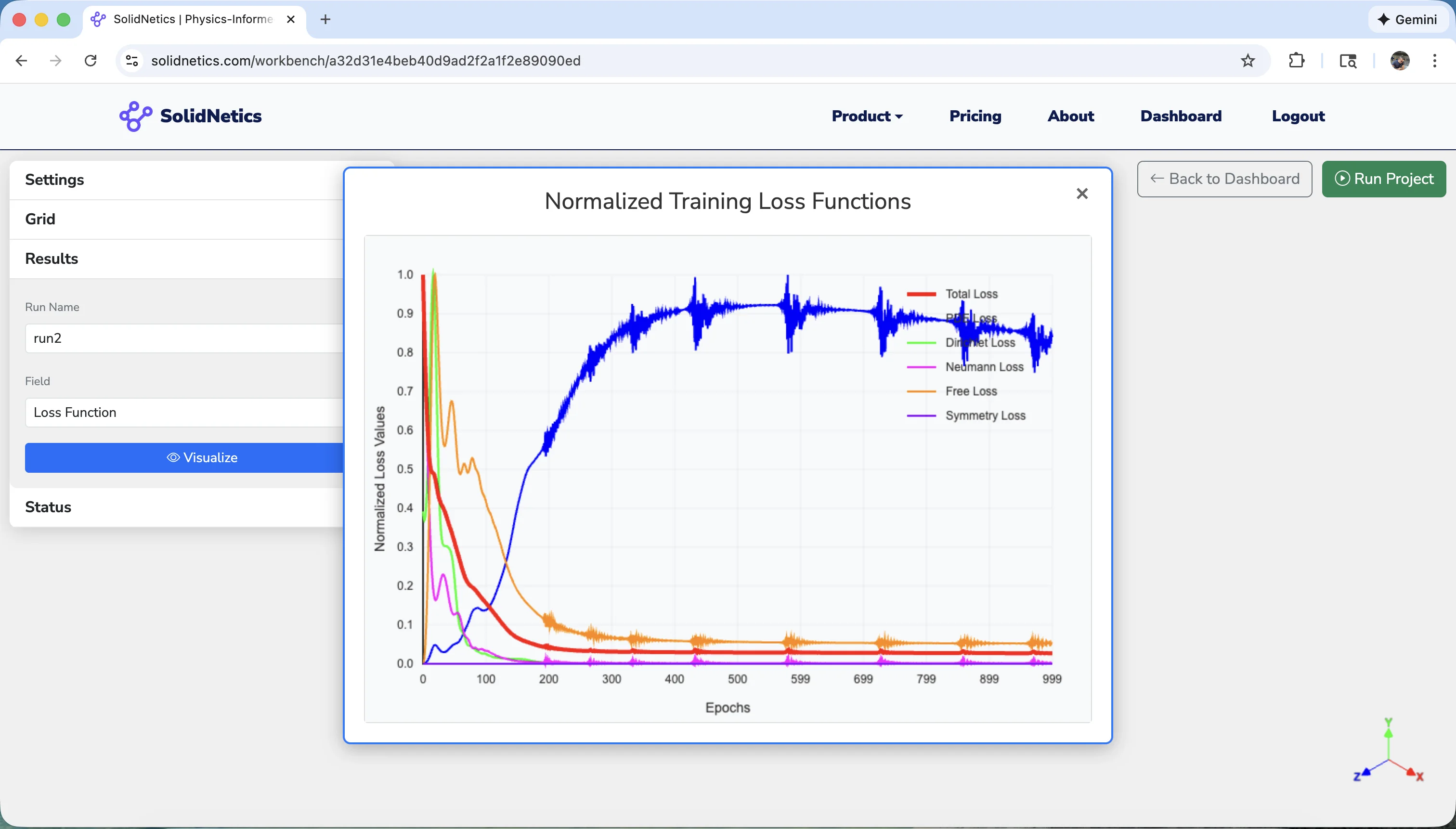
Powered by cloud GPUs on AWS
Training a PINN is the GPU-heavy part — and it's elastic:
- GPU-accelerated training on cloud workers
- No local CUDA install, no driver compatibility
- Status dashboard with epoch progress, loss curves, queue position
- Project-based workflow with multiple runs, variants, and architectures
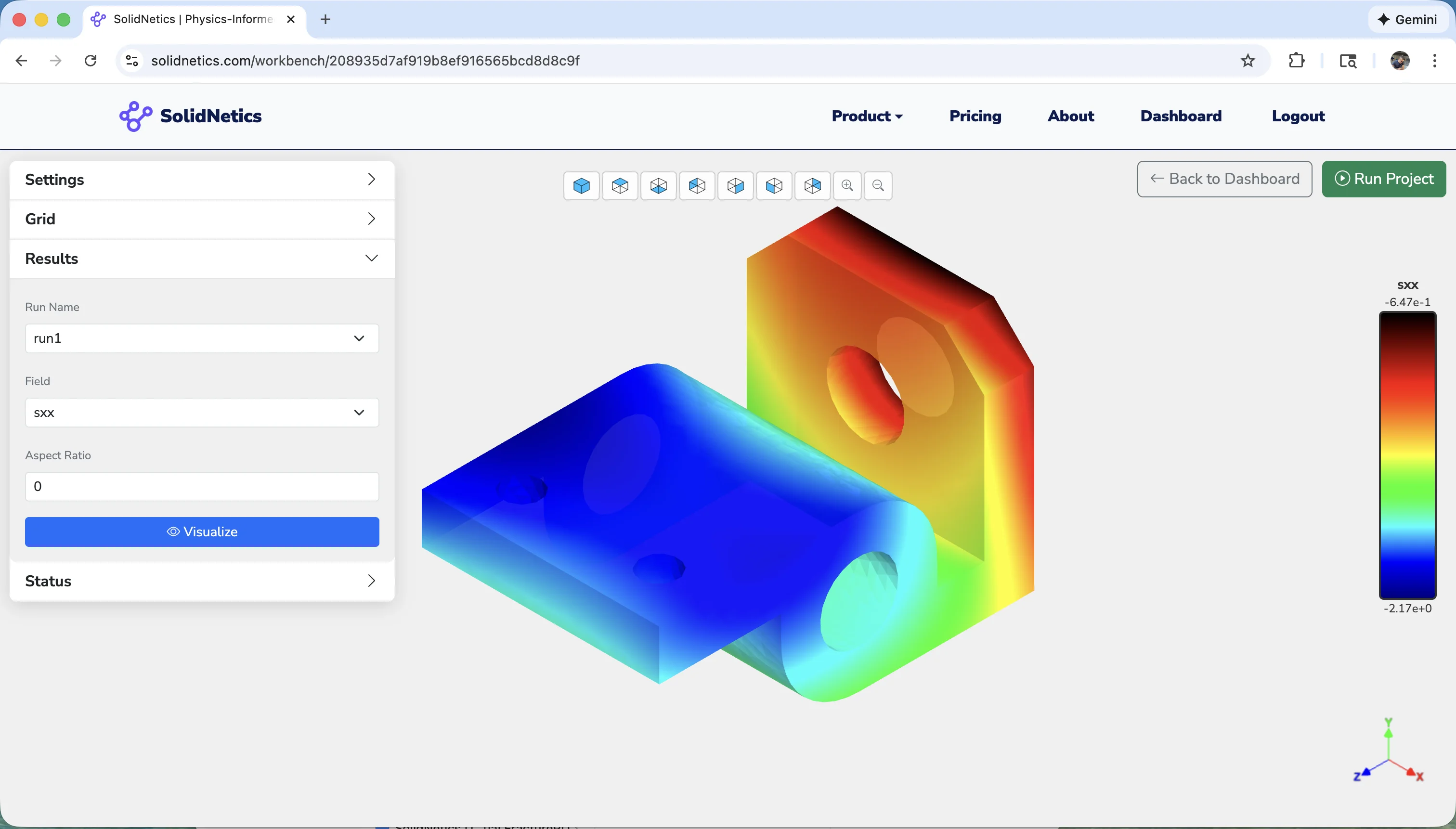
Why cloud-based PINN
PINN training needs a GPU. SolidNetics provides them on demand — no local CUDA install, no licensing headaches, no waiting for a free workstation.
Cloud GPU acceleration
Training runs on AWS GPU instances. Scale up for large meshes, scale down between runs — pay only for what you use.
Access from anywhere
Windows, Mac, Linux, tablets — your PINN models and trained networks travel with you, available in the browser.
Always up to date
New architectures, loss formulations, and optimisers roll out automatically — no recompile.
Designed for ease of use
Three steps from CAD upload to a trained, queryable neural-network solution.
Upload CAD & set boundaries
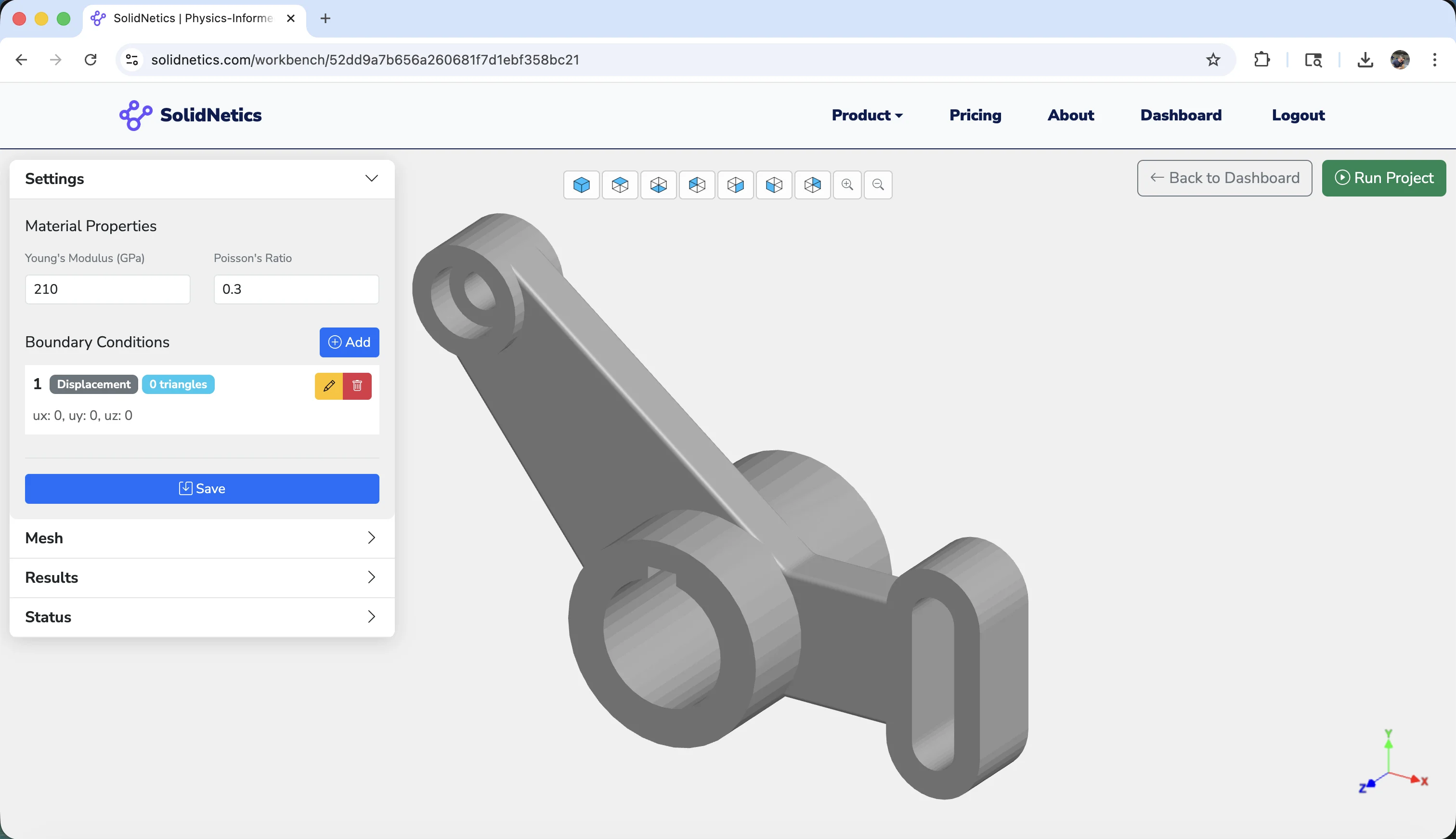
Drop in STL / STEP / IGES, set material properties, click surfaces to apply boundary conditions.
Sample & train on cloud GPU
Geometry sampled as collocation points, network trained on AWS GPU with live loss tracking.
Query the trained model
Evaluate displacement, strain, and stress fields anywhere in the geometry — visualised in 3D.
Applications
Built for engineers exploring mesh-free physics, research teams developing novel network architectures, and design teams that need fast, continuous-field stress predictions.
Mesh-free stress analysis in the cloud
Skip the mesh. Train the network. Query the field. PINN is the modern, AI-native alternative to traditional FEM — built for engineers who want to think in physics, not elements.