AMFusionMap
The surrogate that makes the stack fast. FusionMap learns FusionCore's physics from one offline campaign, then predicts the part-scale fields in seconds instead of hours — and closes the loop that tunes laser power and speed location-by-location.
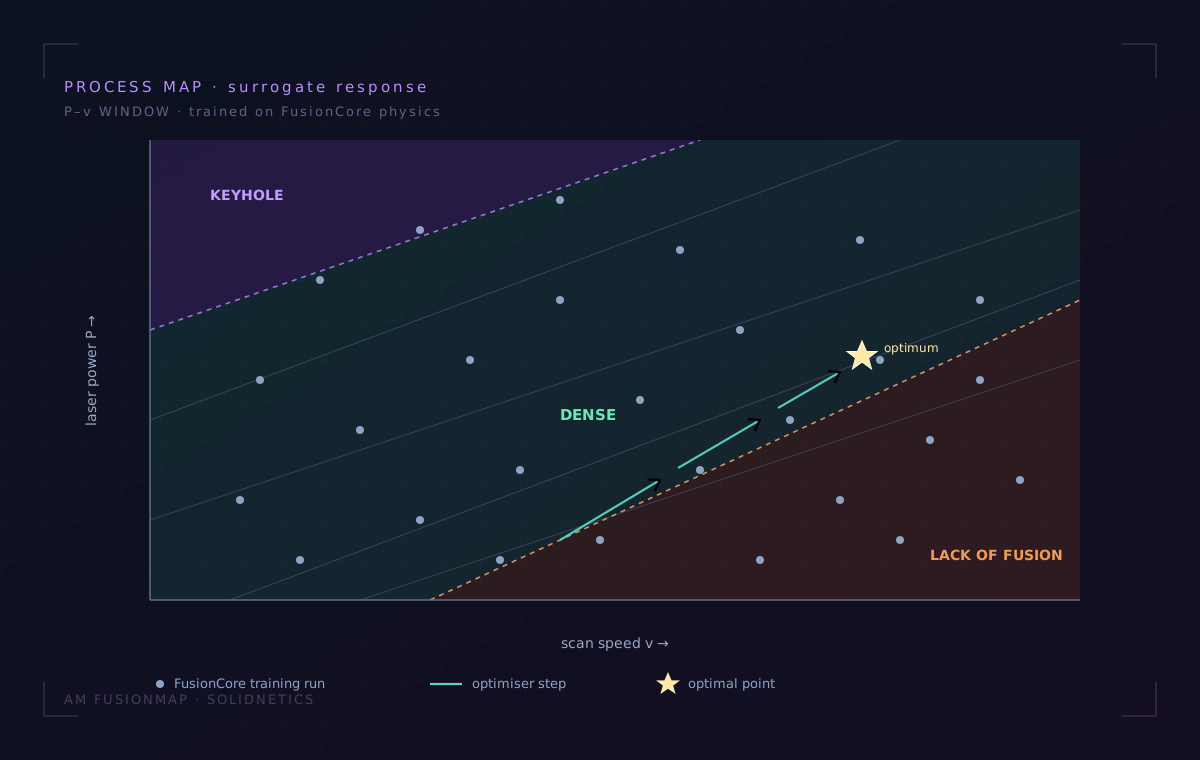
What FusionMap is
FusionMap is the acceleration layer of the AM module. Not a sixth solver — it stands in for FusionCore at runtime, turning hour-long physics solves into second-long surrogate evaluations.
Learns the physics
Runs a FusionCore campaign across the process window and trains a surrogate on the resulting feature–response data — per material.
Predicts everywhere
Loads the pretrained model and evaluates it at every voxel to produce the G–R and inherent-strain maps the part-scale solvers need — no FusionCore at runtime.
Closes the loop
Because a prediction takes seconds, an optimiser can iterate on PathWeaver's per-location parameters until the part meets its stress and time targets.
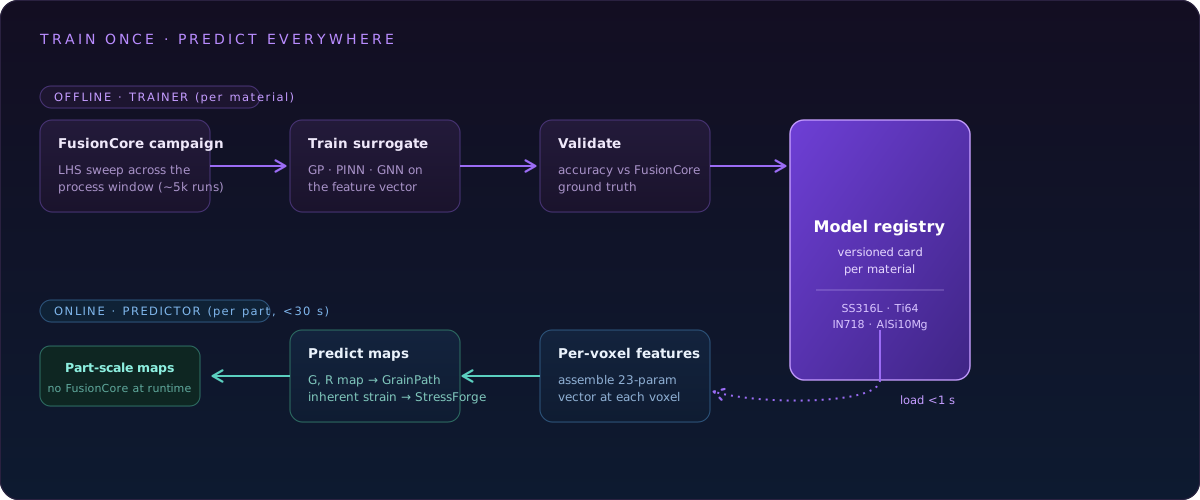
Train once, predict everywhere
Two lanes joined by a versioned model registry. The offline lane runs a FusionCore campaign, trains a surrogate, validates it, and writes a versioned card. The online lane loads that card, assembles a per-voxel feature vector, and predicts the G–R and inherent-strain maps — in under thirty seconds.
Capabilities
Six features that make a surrogate engine viable inside a production AM stack.
Hours to seconds, per evaluation
FusionMap's whole reason to exist: one campaign, then practical inference at runtime.
- Training pulls from a ~5 000-run FusionCore campaign across the process window
- Per-material surrogate trained once — reused across every part
- Per-part prediction takes seconds, even at part scale
- Active learning re-runs FusionCore only when the optimiser leaves the trained range
A ~23-parameter feature vector per voxel
Each voxel encoded as a compact feature vector — sampled across the process window by a tiered Latin-hypercube design:
- Laser · power, scan speed, spot size, absorptivity
- Geometry · local part thickness, distance to surface, layer index
- Thermal state · pre-heat, cool-down between passes, neighbour history
- Strategy · hatch spacing, rotation, fill type
One vector in → G, Ṫ, R, and inherent-strain prediction out.
voxel[14201]
  laser   P=280  v=950  r₀=70  η=0.62
  geom    h=2.1  d_surf=0.4  layer=247
  thermal T₀=180  ΔT_neigh=420
  strat   hatch=0.10  rot=67°  type=island
  → G̃  = 1.7e7 K/m
  → R̃  = 0.61 m/s
  → ε*  = (0.0021, 0.0019, -0.0007)
Three surrogate backends
Different prediction tasks need different model classes — FusionMap supports three backends, swappable per task:
- Gaussian Process (GP) · process map regions; principled uncertainty bounds
- Physics-Informed Neural Net (PINN) · continuous fields with conservation constraints baked in
- Graph Neural Net (GNN) · part-scale field prediction with mesh topology preserved
Each backend ships with its own validation set and accuracy bands.
Versioned model registry
Every surrogate prediction is traceable back to the FusionCore version that trained it:
- One versioned model card per (material × backend) pair
- Card records the FusionCore commit, training-corpus hash, validation metrics, and confidence bounds
- Re-training writes a new version — never overwrites the old one
- Predictions stamp the model version into their output for full reproducibility
Machine calibration without retraining
Different LPBF machines vary in absorptivity, optical chain, and gas flow. FusionMap absorbs that with a learned correction on top of the base surrogate:
- A small set of single-track calibration runs on the real machine
- Calibration fits a per-machine correction — no full retraining
- Same model card, machine-specific correction layered on top
- Reduces the gap between simulated and measured melt-pool to within a few %
per machine
not hours
vs measured pool
or after service
Closed-loop optimisation, end-to-end
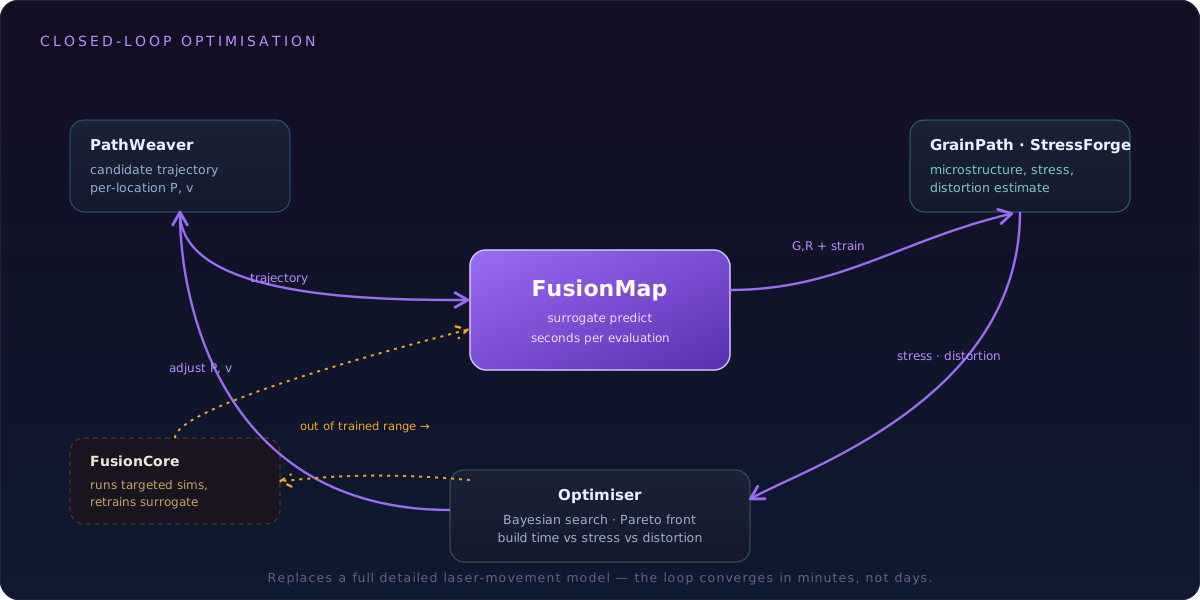
The differentiator. With FusionMap inside the product, an optimiser can sit on top of the stack and iterate:
- PathWeaver proposes a candidate trajectory (per-location P, v)
- FusionMap predicts G, R, and inherent strain across the part
- GrainPath and StressForge evaluate microstructure, stress, distortion
- Optimiser searches the Pareto front of build time × stress × distortion
- Active learning triggers a FusionCore re-run only when needed
The loop converges in minutes, not days.
Where it sits
FusionMap is not a sixth solver — it is the acceleration layer between the physics engine and the part-scale predictors, standing in for FusionCore at runtime.
Who consumes FusionMap
FusionMap doesn't produce a user-visible output of its own. Two downstream solvers consume its predictions directly:
GrainPath
Solidification fields drive the columnar-to-equiaxed transition map, grain morphology, and texture prediction for microstructure.
StressForge
Per-voxel inherent-strain tensor feeds the layer-by-layer part-scale FEM solve for residual stress, warping, and distortion.
Why a surrogate engine matters
Sub-minute part predictions
Iterating on a part takes seconds per evaluation, not hours. Engineers stay in the design loop instead of waiting on overnight runs.
Closes the optimisation loop
Without a surrogate, you predict once and adjust by hand. With FusionMap, you let an optimiser drive PathWeaver's parameters end-to-end.
Traceable physics
Every prediction pins back to the FusionCore version that trained it — a defensible chain from voxel to validated physics.
Used internally — felt everywhere
FusionMap powers GrainPath and StressForge behind the scenes. To use it, run a part-scale prediction with either solver — the surrogate is invoked automatically.